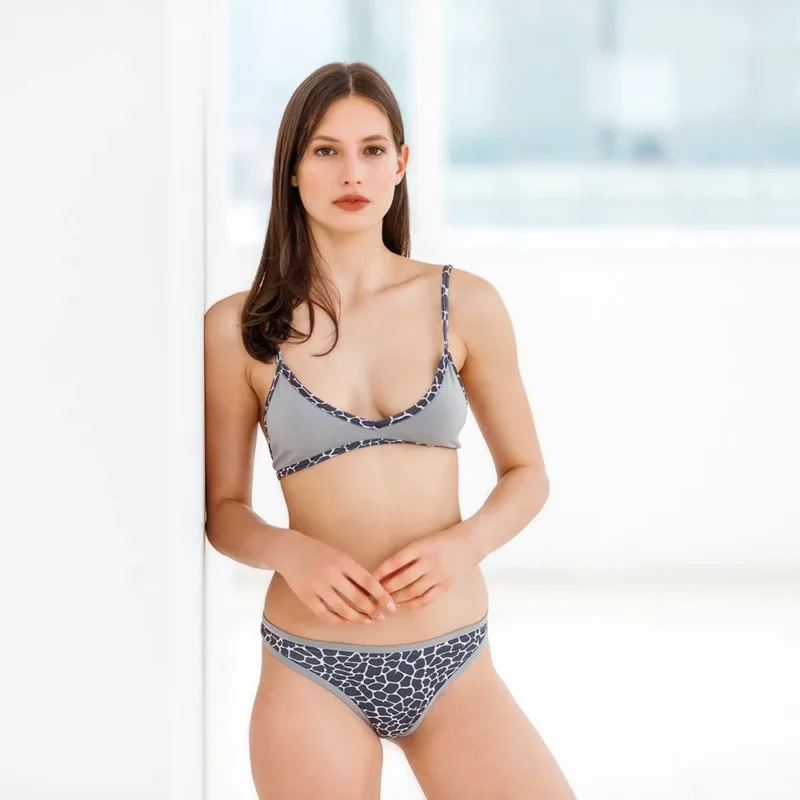
Applications
Circular knitting machines for underwear
Machines for adult and baby underwear, nightwear, leggings and thermal garments, where fine gauge and soft hand feel carry the product.
Recommended machine types
What to put on the floor
These are the machine types we normally quote for underwear. Tell us the fabric weight and expected output and we narrow it to one configuration.
- Single Jersey
- Single Terry
- Single Reverse Plated Loop
- Interlock
- Rib
- Single Computerized Terry Jacquard
- Single Jersey Computerized Jacquard
Machine names follow our catalogue naming. Not every model is stocked for every market — availability is confirmed with the quotation.
SPECIFICATION
Fine gauge and elastane control decide underwear fabric
Underwear is the most gauge-sensitive garment in the plant. The fabric is thin, the elastane content is high, and every needle line shows through a seam. Machine selection is driven by stitch density and by how precisely the elastane can be plated.
| Product | Typical GSM | Gauge | Diameter | Feeds | Elastane |
|---|---|---|---|---|---|
| Seamless brief | 140–200 | E28–E36 | 30″ | 84–96 | plated 10–20% |
| Boxer and trunk | 160–220 | E24–E32 | 30″–34″ | 72–96 | plated 8–15% |
| Camisole and lining | 120–180 | E28–E36 | 30″ | 84–96 | 0–10% |
| Cotton-rich jersey body | 150–200 | E24–E28 | 30″–34″ | 72–96 | 0% or light plating |
| Elastic band and trim | 240–360 | E14–E18 | 30″–34″ | 36–54 | plated 15–25% |
E36 and finer require needle and sinker quality that a general-purpose spare-parts kit will not deliver. On fine gauge, needle wear shows up as a visible line long before it affects running efficiency, so the inspection interval matters more than the initial needle price.
SPECIFICATION
Four underwear defects that survive a visual check
- Edge curl on seamless panels. The fabric rolls at the cut edge because the elastane is not balanced across the face and back. It appears after relaxation, so approve the sample washed and rested, not straight off the machine.
- Grin-through at high extension. Face yarn opens under stretch and the elastane becomes visible. Increasing density or changing the plating ratio fixes it; running the machine faster does not.
- Barré from feeder tension imbalance. On a 96-feed machine at fine gauge, a single feeder running 5% tighter produces a faint band across the whole garment. Feeder tension is checked per head, not per machine.
- Needle lines after lamination or bonding. Bonding presses a fine gauge fabric against adhesive; any density variation becomes a visible line. Inspect before bonding, because the defect cannot be corrected afterwards.
QUALITY
Tests that decide an underwear fabric approval
- Stretch and recovery — cyclic extension testing with a defined extension and recovery limit; this is the property that fails first in wear.
- Dimensional change — ISO 6330 wash, ISO 5077 measurement; cotton-rich bodies commonly move more than synthetic ones.
- Colour fastness to washing and perspiration — ISO 105-C06 and ISO 105-E04, typically grade 4 minimum for next-to-skin fabric.
- Pilling and surface change — ISO 12945-2, relevant where the fabric is brushed or has a raised inner face.
- Fabric thickness and hand — measured on the finished, relaxed fabric, because fine gauge changes noticeably after washing.
Because a single needle line rejects a whole garment, defect control on underwear is a daily discipline rather than a final inspection. The fabric defect guide gives the check order, and the supplier audit checklist covers needle and sinker supply depth.
FAQ
Questions buyers ask about underwear
Which circular knitting machine is used for underwear?
The usual starting points are Single Jersey, Single Terry, Single Reverse Plated Loop. The final choice depends on fabric weight, required stretch and the gauge you sell, so we confirm the configuration against a fabric sample rather than a catalogue page.
What do you need from us to quote a machine for underwear?
Fabric type and weight, required gauge and cylinder diameter, expected output per shift, and the destination port. With those we return a configuration sheet with price and lead time.
What is the lead time and warranty?
Machines are built in 20–45 working days depending on model and configuration, then 20–45 days by sea freight. Machines carry a 12-month warranty from delivery; needles and spare parts follow the period stated on the invoice.
What gauge is needed for seamless underwear?
E28 to E36 covers most seamless briefs and camisoles, with E36 chosen when the fabric must be thin and dense enough to bond rather than sew. Machine diameter is usually 30 inches with a high feed count.
How much elastane goes into underwear fabric?
Briefs and boxers typically run 8–20% plated elastane, and elastic bands 15–25%. What matters for approval is the recovered fabric behaviour, not the plating percentage on the order sheet.
Why do needle lines show more on underwear than on other knits?
The fabric is thin, the gauge is fine and the garment is worn close to the body, so a one-wale density change has nowhere to hide. It is also often bonded rather than sewn, which removes the seam that would otherwise break up the visual line.

Circular knitting machines, needles and spare parts manufactured in Quanzhou, Fujian and shipped worldwide since 1996.