

Types of Circular Knitting Machines Explained: Single, Double & Jacquard – Rev 2
Choosing the wrong circular knitting machine costs textile manufacturers tens of thousands of dollars in wasted investment and production downtime. With the global circular knitting machine market reaching $6.8 billion in 2025 and growing at 4.2% CAGR, understanding the fundamental machine types is essential for any factory owner, procurement officer, or textile professional.
This guide breaks down every major type of circular knitting machine — from basic single jersey to computerized jacquard — so you can make an informed purchasing decision that matches your production needs.
What Is a Circular Knitting Machine?
A circular knitting machine is a specialized textile machine that produces tubular or flat knitted fabric by feeding yarn through a rotating cylinder equipped with needles. Unlike flatbed knitting machines, circular machines operate continuously at high speeds, making them ideal for mass production of apparel, technical textiles, and industrial fabrics.
The core components of every circular knitting machine include:
- Cylinder — The rotating drum that holds the needles
- Needles — Latch, bearded, or compound needles that form loops
- Sinkers — Control fabric movement and loop formation
- Cams — Guide needle movement through the knitting cycle
- Yarn feeders — Deliver yarn at consistent tension
- Take-down system — Pulls finished fabric away from the needle zone
The key differentiator between machine types is the number of needle beds (single vs. double) and the patterning capability (plain vs. jacquard).
Single Jersey (Single-Face) Circular Knitting Machines
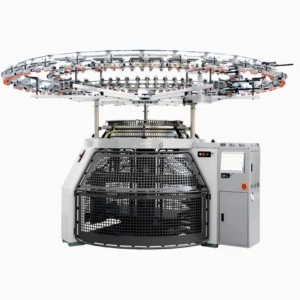
Single jersey machines have one cylinder with one set of needles and sinkers. They produce lightweight, elastic single-face knitted fabric for T-shirts, underwear, casual wear, and lining materials.
Key Specifications
| Parameter | Typical Range |
|---|---|
| Cylinder diameter | 14″ – 40″ |
| Gauge | E18 – E40 |
| Number of feeders | 8 – 72 |
| Rotational speed | 28 – 40 RPM |
| Production output | 800 – 1,200 lbs per 24 hours |
| Power consumption | 0.7 – 1.1 kWh/kg |
Sub-Types of Single Jersey Machines
1. Plain Single Jersey Machines
The most basic and widely used type. Produces standard single jersey fabric with a smooth face and a slightly textured back. Ideal for T-shirt and polo shirt fabric, undergarments, lining materials, and base fabric for printing. Advantages: High speed, low maintenance, affordable spare parts, easy operation.
2. Single Jersey Jacquard Machines
Equipped with a pattern selection mechanism that controls individual needles. Mechanical (Small) Jacquard: Uses physical selection mechanisms for quick pattern changes. Best for small-batch production. Computerized (Large) Jacquard: Electronic needle selection supports 4–8 color changes for complex patterns. Best for mass production of fashion textiles.
3. Terry Single Jersey Machines
Specialized machines that produce terry/loop fabric on a single jersey base. Applications: Towels, bathrobes, casual wear, baby clothing.
4. Auto Striper Single Jersey Machines
Programmable yarn feeders automatically change yarn colors to create horizontal stripe patterns. Applications: Striped T-shirts, sportswear, fashion basics.
5. Three-Thread Fleece Machines
Produce fleece fabric by knitting a ground structure while laying in fleece yarn that is later brushed. Applications: Sweatshirts, hoodies, thermal underwear, baby blankets.
Double Jersey (Double-Face) Circular Knitting Machines
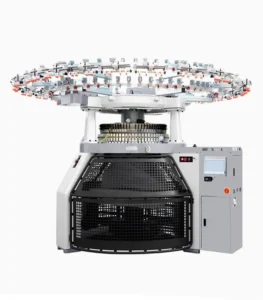
Double jersey machines have two needle beds — a lower cylinder and an upper dial arranged at 90 degrees to each other. The two sets of needles work simultaneously to produce thicker, more stable fabrics with less curl than single jersey.
Key Specifications
| Parameter | Typical Range |
|---|---|
| Cylinder diameter | 12″ – 42″ |
| Gauge | E12 – E28 |
| Number of feeders | 6 – 48 |
| Rotational speed | 20 – 30 RPM |
| Production output | 500 – 900 lbs per 24 hours |
Sub-Types of Double Jersey Machines
1. Rib Double Jersey Machines
Needles on the cylinder and dial are placed at right angles (90 degrees). Produces rib fabric with vertical lines on both sides and excellent crosswise elasticity. Applications: Cuffs, collars, waistbands, underwear, sweater ribbing, polo shirt collars.
2. Interlock Double Jersey Machines
Needles on the cylinder and dial are placed opposite and alternating. Produces interlock fabric — smooth on both sides, stable, with less stretch than rib. Applications: High-quality T-shirts, dress shirts, baby clothing, sportswear, medical textiles.
3. Pique Double Jersey Machines
A variation of interlock machines with a modified cam system that creates a textured, waffle-like surface. Produces pique fabric commonly used for polo shirts. Applications: Polo shirts, fashion knitwear, uniform shirts.
4. Double Jersey Jacquard Machines
Combine double-face knitting with jacquard patterning capability. Computerized versions support complex multi-color patterns on double jersey structures including Jacquard interlock, Jacquard rib, Milano rib patterns, and Pointelle designs. Applications: High-end fashion, branded sportswear, automotive textiles.
Classification by Needle Type
Latch Needle Machines
The most common type in modern textile manufacturing. Latch needles have a hinged latch that opens and closes automatically during the knitting cycle. Advantages: High speed capability, easy maintenance, widely available spare parts. Used in single jersey, double jersey, jacquard, terry, and fleece machines.
Bearded Needle Machines
Use bearded needles with a flexible beard that is pressed closed by a presser. Produce very uniform loops, suitable for fine gauges. Limitations: Lower speed, more complex maintenance. Used in sinker wheel machines and loop wheel frames.
Compound Needles
Feature a separate closing element that moves independently of the needle body. Provide precise loop control with reduced yarn tension. Used in high-precision machines for technical textiles and fine-gauge fabrics.
How to Choose the Right Circular Knitting Machine
Selecting the right machine depends on five critical factors:
1. Fabric Type You Need to Produce
| Fabric Type | Required Machine |
|---|---|
| Single jersey (T-shirt fabric) | Single jersey machine |
| Rib fabric (cuffs, collars) | Rib double jersey machine |
| Interlock fabric (premium T-shirts) | Interlock double jersey machine |
| Pique fabric (polo shirts) | Pique double jersey machine |
| Terry fabric (towels) | Terry single jersey machine |
| Fleece fabric (sweatshirts) | Three-thread fleece machine |
| Patterned fabrics | Jacquard machine (single or double) |
2. Production Volume
- High volume, single product: Dedicated plain machines for maximum speed and lowest cost per kg
- Medium volume, multiple products: Versatile machines with quick changeover capability
- Low volume, frequent changes: Jacquard machines with computerized pattern control
3. Yarn Type and Count
- Fine yarns (Nm 60-100): High-gauge machines (E28-E40)
- Medium yarns (Nm 30-60): Medium-gauge machines (E18-E28)
- Coarse yarns (Nm 10-30): Low-gauge machines (E12-E18)
- Elastic yarns: Machines with specialized yarn feeders and tension control
4. Budget Considerations
| Machine Type | Approximate Price Range |
|---|---|
| Plain single jersey | $80,000 – $150,000 |
| Plain double jersey | $100,000 – $180,000 |
| Mechanical jacquard | $120,000 – $200,000 |
| Computerized jacquard | $200,000 – $350,000+ |
| Specialty (terry, fleece) | $100,000 – $200,000 |
Note: Prices vary significantly by manufacturer, specifications, and origin. Chinese manufacturers typically offer 30-50% lower prices than European brands.
5. Total Cost of Ownership (10-Year)
| Cost Component | % of Total |
|---|---|
| Acquisition | 35–45% |
| Energy | 25–30% |
| Maintenance | 15–20% |
| Spare parts | 10–15% |
Energy-efficient machines with inverter drives and automatic lubrication reduce long-term costs by 20-30%.
Quick Reference: Machine Type Comparison
| Feature | Single Jersey | Double Jersey | Jacquard |
|---|---|---|---|
| Needle beds | 1 | 2 | 1 or 2 |
| Fabric thickness | Light | Medium-Heavy | Varies |
| Elasticity | High | Medium | Varies |
| Speed | High (28-40 RPM) | Medium (20-30 RPM) | Low-Medium |
| Pattern capability | Plain only | Plain only | Complex patterns |
| Price | $ | $$ | $$$ |
| Maintenance complexity | Low | Medium | High |
Frequently Asked Questions
Q: What is the difference between single jersey and double jersey circular knitting machines?
A: Single jersey machines have one needle bed and produce lightweight, elastic fabric with a smooth face and textured back. Double jersey machines have two needle beds (cylinder + dial) and produce thicker, more stable fabric that lies flat without curling. Single jersey is ideal for T-shirts; double jersey is better for polo shirts, interlock fabrics, and structured garments.
Q: Can a single jersey machine produce rib fabric?
A: No. Rib fabric requires two needle beds (cylinder and dial) that work simultaneously. A single jersey machine only has one needle bed and cannot produce rib, interlock, or other double-face structures. You need a rib double jersey machine for rib fabric production.
Q: What is the difference between mechanical and computerized jacquard machines?
A: Mechanical jacquard machines use physical selection mechanisms (wheels, drums, dobbies) to control needles. They are slower but allow quick pattern changes and are more affordable. Computerized jacquard machines use electronic needle selection controlled by computer programs. They support complex multi-color patterns and higher precision but cost significantly more.
Q: How do I choose the right gauge for my circular knitting machine?
A: Gauge determines fabric fineness. Higher gauge (E28-E40) produces fine, lightweight fabrics from fine yarns. Lower gauge (E12-E18) produces heavier fabrics from coarse yarns. Match the gauge to your target fabric weight and yarn count. For apparel, E18-E28 covers most applications.
Q: What is the production capacity of a circular knitting machine?
A: Production capacity depends on cylinder diameter, gauge, RPM, and efficiency. A standard 34-inch single jersey machine at 24G running 32 RPM at 90% efficiency produces approximately 280-320 kg per 8-hour shift. Double jersey machines produce 20-30% less due to lower RPM.
Q: How often do circular knitting machine needles need to be replaced?
A: Needle replacement intervals average 8,000-12,000 operating hours under normal conditions. However, needle life depends on yarn type, machine speed, and maintenance quality. Needles should be replaced in batches (by feeder unit) to ensure uniform fabric quality. Replacing a single needle among worn needles causes visible fabric defects.
Conclusion
Understanding the types of circular knitting machines is the first step toward making a smart investment. Single jersey machines offer the best value for high-volume plain fabric production. Double jersey machines provide versatility for rib, interlock, and pique fabrics. Jacquard machines unlock patterning capability for fashion and branded textiles.
The right choice depends on your specific fabric requirements, production volume, yarn types, and budget. At Aisunny, we manufacture and supply all types of circular knitting machines and spare parts, with over 15 years of experience serving textile factories worldwide. Contact us for a free quote to find the perfect machine for your production needs.