

Introduction
Choosing the right circular knitting machine is one of the most consequential decisions a textile manufacturer can make. The choice between a single jersey and a double jersey machine shapes everything — from the fabrics you can produce and the speed at which you produce them, to your capital expenditure and long-term maintenance costs.
Yet the decision isn’t always straightforward. Both machine types serve essential roles in the textile industry, and each excels in different applications. A T-shirt factory has very different needs than a sportswear manufacturer. A high-volume basics producer faces different trade-offs than a specialty knitwear brand.
This guide breaks down the differences between single jersey and double jersey circular knitting machines across every dimension that matters: construction, fabric characteristics, production efficiency, cost, applications, and long-term operational considerations. By the end, you’ll have a clear framework for choosing the right machine — or the right combination of machines — for your specific production goals.
What Is a Single Jersey Circular Knitting Machine?
Construction and Working Principle
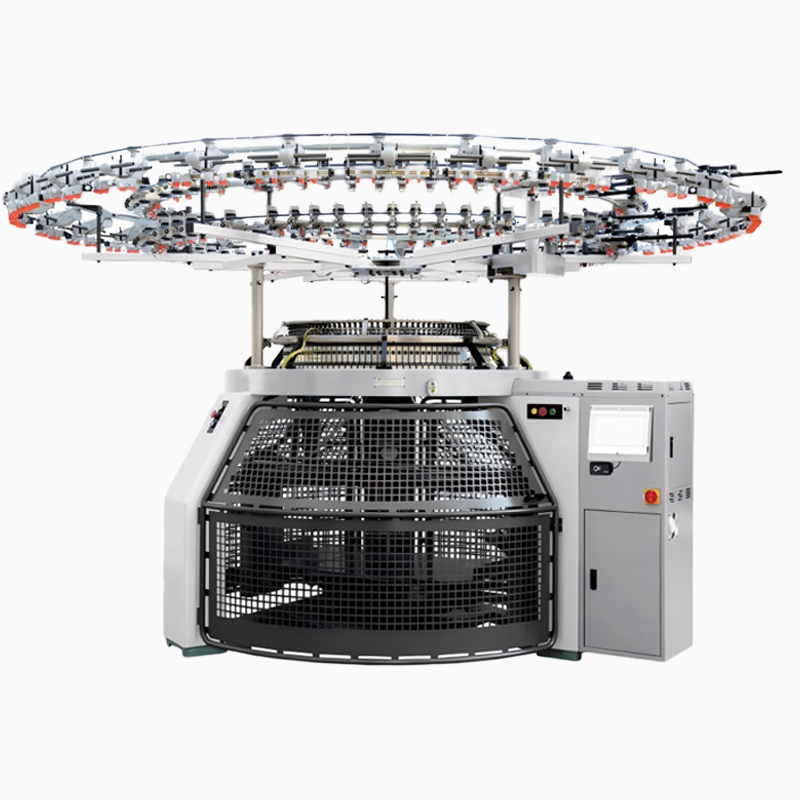
A single jersey circular knitting machine has a single cylinder of needles — one set of latch needles and one set of sinkers arranged in a circular configuration. The cylinder diameter typically measures around 30 inches, though this varies by manufacturer and model.
The knitting process is straightforward: yarn feeds into the needle hooks as the cylinder rotates, forming loops in a single direction. The sinkers play a critical role in this process, holding the fabric down and assisting in loop formation. This single-bed, unidirectional knitting creates a fabric with a distinct right side and wrong side.
Fabric Characteristics
Single jersey fabrics are defined by their single-layer construction:
- Lightweight and breathable — ideal for warm-weather garments and base layers
- Smooth face, textured back — the front shows a clean V-pattern while the back displays loop piles
- Natural stretch — comfortable and flexible, though with less recovery than double knits
- Edge curling tendency — cut single jersey fabric naturally curls toward the face side, which can complicate cutting and sewing operations
- Approximately half the thickness of equivalent double jersey fabric
Common Fabrics Produced
- Plain jersey (the most common single-knit fabric)
- Single jersey piqué
- Lacoste (piqué variant)
- Single terry (with plush loops on the back)
- Fleece (three-thread fleece on specialized single jersey machines)
Advantages
- High production speed — simpler mechanics allow faster rotation speeds, typically 20-30% higher output than double jersey machines of the same diameter
- Lower capital cost — fewer components mean a lower purchase price
- Easier operation and maintenance — single needle bed means fewer adjustments and simpler troubleshooting
- Lower maintenance cost — fewer needles, no dial components, and simpler cam systems reduce ongoing maintenance expenses
- Quick fabric changeover — switching between fabric types is faster due to simpler setup
- Wide availability of spare parts — the most common machine type globally, with extensive parts supply chains
Disadvantages
- Limited design options — restricted to basic patterns and textures without jacquard capability
- Edge curling — requires additional handling during cutting and sewing
- Less fabric stability — single-layer construction means less dimensional stability
- Lower insulation — thinner fabric provides less warmth
- One-sided appearance — the back side has a visibly different texture, limiting design versatility
What Is a Double Jersey Circular Knitting Machine?
Construction and Working Principle
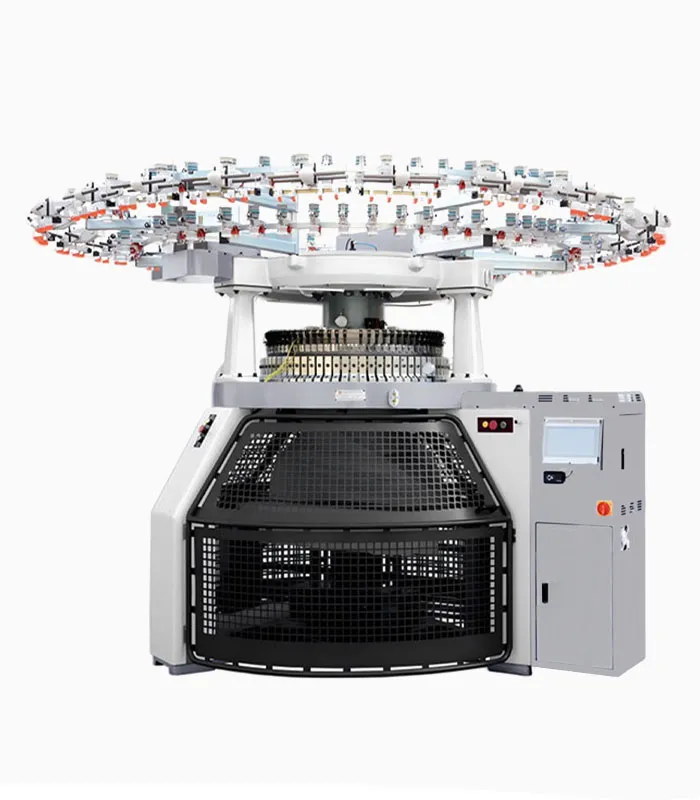
A double jersey circular knitting machine features two sets of needles: one on the vertical cylinder and one on the horizontal dial. These two needle beds are positioned at right angles to each other, allowing simultaneous knitting in two perpendicular directions.
Unlike single jersey machines, double jersey machines do not use sinkers. Instead, the two needle beds interlock their loops to create a unified double-layer fabric. This dual-bed construction is fundamentally more complex, requiring precise synchronization between cylinder and dial movements.
Fabric Characteristics
Double jersey fabrics are defined by their double-layer, interlocked construction:
- Thicker and heavier — approximately twice the thickness of single jersey fabric
- Excellent stability — the interlocked structure resists stretching and deformation
- No edge curling — cut edges lie flat, simplifying downstream operations
- Reversible appearance — both sides of the fabric look similar (in plain interlock construction)
- Better insulation — the double-layer structure traps more air, providing warmth
- Firm hand feel — the fabric has more body and structure than single jersey
Common Fabrics Produced
- Interlock (the most common double-knit fabric)
- Rib (1×1 rib, 2×2 rib, and other rib configurations)
- Double jersey jacquard
- Ponte di Roma
- Milano rib
- Swiss double piqué
Advantages
- Superior fabric quality — more stable, durable, and professional finish
- Design flexibility — wider range of patterns, textures, and structural variations
- No edge curling — simplifies cutting, sewing, and finishing operations
- Reversible fabrics — both sides can serve as the face, expanding design options
- Better shape retention — garments maintain their shape through wear and washing
- Higher perceived value — double jersey fabrics command premium prices in the market
Disadvantages
- Lower production speed — the dual-needle mechanism limits rotation speed, typically 20-30% slower than single jersey machines
- Higher capital cost — more complex construction with additional needle beds, dials, and cam systems
- More complex operation — requires more skilled operators and more frequent adjustments
- Higher maintenance cost — twice as many needles plus dial components increase replacement and maintenance expenses
- Slower fabric changeover — switching between fabric types requires more setup time and expertise
Head-to-Head Comparison
Needle Arrangement
| Feature | Single Jersey | Double Jersey |
|---|---|---|
| Needle beds | 1 (cylinder only) | 2 (cylinder + dial) |
| Needle directions | Vertical only | Vertical + horizontal |
| Sinkers | Required | Not required |
| Loop formation | Unidirectional | Bidirectional (perpendicular) |
Fabric Properties
| Property | Single Jersey | Double Jersey |
|---|---|---|
| Thickness | Light (1x) | Heavy (2x) |
| Weight | Lighter | Heavier |
| Stretch | Higher | Lower (more controlled) |
| Stability | Moderate | High |
| Edge curling | Yes (toward face) | No |
| Reversibility | No (different sides) | Yes (similar sides) |
| Insulation | Lower | Higher |
| Breathability | Higher | Moderate |
| Shape retention | Moderate | Excellent |
Production and Economics
| Factor | Single Jersey | Double Jersey |
|---|---|---|
| Production speed | High (faster RPM) | Medium (slower RPM) |
| Capital cost | Lower ($) | Higher ($$) |
| Operating cost | Lower | Higher |
| Maintenance cost | Lower | Higher |
| Operator skill required | Basic | Intermediate+ |
| Fabric changeover | Fast | Slower |
| Spare parts availability | Excellent | Good |
Applications Comparison
| Application | Single Jersey | Double Jersey |
|---|---|---|
| T-shirts | ✅ Primary choice | ⚠️ Overkill for basic tees |
| Underwear/lingerie | ✅ Ideal | ⚠️ Too heavy |
| Casual wear | ✅ Ideal | ✅ Good for structured pieces |
| Sportswear | ✅ Good for lightweight | ✅ Better for structured |
| Polo shirts | ⚠️ Acceptable | ✅ Preferred (interlock) |
| Sweaters | ❌ Too thin | ✅ Ideal |
| Winter clothing | ❌ Insufficient | ✅ Ideal |
| Upholstery | ❌ Not durable enough | ✅ Suitable |
| Rib trims (collars, cuffs) | ❌ Cannot produce | ✅ Primary application |
| Dresses | ✅ Good for casual | ✅ Good for structured |
| Baby clothing | ✅ Soft and light | ✅ Durable and stable |
How to Choose: Decision Framework
Choose Single Jersey If…
- You prioritize volume over variety — When your business model depends on producing large quantities of basic fabrics at the lowest per-unit cost
- Your products are lightweight basics — T-shirts, underwear, casual wear, and summer garments
- You’re entering the market — Lower capital investment and easier operation make single jersey machines ideal for new manufacturers
- You need fast changeovers — When your production schedule requires frequent switches between fabric types
- Your labor market has limited skilled operators — Simpler machines require less training
Choose Double Jersey If…
- You produce premium or structured garments — Polo shirts, sweaters, winter wear, and fashion knitwear
- Fabric quality is your competitive advantage — When your customers expect superior hand feel, stability, and finish
- You need rib or interlock fabrics — These can only be produced on double jersey machines
- You serve brands with strict quality requirements — The no-curl, reversible, stable nature of double jersey fabrics meets higher quality standards
- You have the operational capacity — Skilled operators, maintenance capability, and capital budget for the more complex machine
Consider Both If…
Many successful textile manufacturers operate both machine types. A common configuration is:
- Single jersey machines for high-volume basics (T-shirts, casual wear, underwear)
- Double jersey machines for premium products (polo shirts, structured sportswear, winter garments)
This dual approach maximizes both volume and product range, allowing a factory to serve diverse market segments.
Cost Analysis: Single Jersey vs Double Jersey
Purchase Price Ranges (2026 Market)
| Machine Type | Typical Price Range (USD) | Notes |
|---|---|---|
| Single Jersey (basic) | $15,000 – $30,000 | Standard diameter, manual striper |
| Single Jersey (computerized) | $30,000 – $50,000 | Electronic jacquard, auto-striper |
| Double Jersey (basic) | $20,000 – $40,000 | Standard rib/interlock |
| Double Jersey (computerized) | $40,000 – $80,000+ | Electronic jacquard, advanced features |
Prices vary significantly by manufacturer, diameter, gauge, and feature set. Chinese manufacturers like Aisunny typically offer competitive pricing in these ranges.
Total Cost of Ownership (5-Year Estimate)
| Cost Factor | Single Jersey | Double Jersey |
|---|---|---|
| Purchase price | $25,000 (avg) | $35,000 (avg) |
| Annual maintenance | $1,500 – $2,500 | $2,500 – $4,000 |
| Needle replacement (annual) | $500 – $1,000 | $1,000 – $2,000 |
| Energy consumption | Lower | Higher |
| Operator training | Lower | Higher |
| 5-year TCO | $35,000 – $42,000 | $50,000 – $62,000 |
The double jersey machine’s higher total cost of ownership is offset by the premium prices its fabrics command in the market. A factory producing interlock polo shirts can typically charge 20-40% more per garment than one producing basic single jersey T-shirts.
Maintenance Considerations
Single Jersey Maintenance
- Needle inspection: Check latch needles every 2-4 weeks for hook damage, latch wear, and spring tension
- Sinker maintenance: Sinkers require regular cleaning and occasional replacement — they’re subject to significant wear
- Cam system: Single set of cams is simpler to maintain and adjust
- Oil changes: Standard lubrication schedule (refer to manufacturer specifications)
- Common issues: Needle breaks, sinker wear, yarn feeder malfunctions
Double Jersey Maintenance
- Needle inspection: Both cylinder and dial needles must be inspected — effectively double the needle maintenance
- Dial alignment: The dial must be precisely aligned with the cylinder; misalignment causes dropped stitches and fabric defects
- Dual cam systems: Both cylinder and dial cam systems require separate maintenance
- Synchronization: The timing between cylinder and dial movements must be periodically verified
- Common issues: Dial misalignment, timing errors, more frequent needle breaks due to dual-bed stress
Frequently Asked Questions
Q1: Can a double jersey machine produce single jersey fabric?
No. The dual-needle system of a double jersey machine inherently creates double-layered fabrics. While some advanced machines offer limited flexibility, a dedicated single jersey machine is always more efficient for single-layer production.
Q2: Which machine is better for T-shirt production?
For basic T-shirts, a single jersey machine is the better choice — it produces the lightweight, breathable fabric that T-shirts require, at higher speeds and lower cost. However, for premium T-shirts or polo shirts using interlock fabric, a double jersey machine is necessary.
Q3: What is the main difference in fabric between single and double jersey?
The fundamental difference is layer count. Single jersey has one layer with a smooth face and looped back, while double jersey has two interlocked layers with similar appearances on both sides. Double jersey is thicker, more stable, and doesn’t curl at the edges.
Q4: How much faster is a single jersey machine compared to double jersey?
Single jersey machines typically operate 20-30% faster than double jersey machines of the same diameter and gauge. The exact difference depends on the specific machine models, fabric type, and production conditions.
Q5: Is double jersey fabric better than single jersey?
“Better” depends on the application. Double jersey is superior for structured, premium, and cold-weather garments. Single jersey is superior for lightweight, breathable, and cost-sensitive products. Neither is universally better — they serve different market segments.
Q6: What is interlock fabric?
Interlock is a type of double jersey fabric produced on a double jersey circular knitting machine. It features two layers of plain jersey knitted together back-to-back, resulting in a smooth, stable, reversible fabric that doesn’t curl. It’s widely used for polo shirts, baby clothing, and premium casual wear.
Q7: Which machine should a new textile factory buy first?
Most manufacturers start with single jersey machines because of their lower cost, simpler operation, and versatility for the most common textile products (T-shirts, casual wear). Double jersey machines are typically added later as the business expands into premium product lines.
Conclusion
The choice between single jersey and double jersey circular knitting machines isn’t about which machine is objectively better — it’s about which machine aligns with your production goals, target market, and operational capabilities.
Single jersey machines win on speed, cost, and simplicity. They’re the workhorses of the textile industry, producing the lightweight fabrics that dominate everyday wardrobes. If your business is built on volume and efficiency, single jersey is your foundation.
Double jersey machines win on quality, versatility, and fabric value. They produce the structured, stable, premium fabrics that command higher prices and serve demanding applications. If your business is built on quality and differentiation, double jersey is your edge.
The most successful textile manufacturers understand that these machines are complementary, not competing. Building a production line that includes both types — matched to the right products and markets — is the path to sustainable growth in the competitive textile industry.