

Circular Knitting Machine Needle Types: How to Choose the Right Needles for Your Fabric
Choosing the right needles for your circular knitting machine isn’t just a maintenance decision — it’s a production decision. The wrong needle type causes fabric defects, increases downtime, and wastes yarn. The right needle improves fabric quality, extends machine life, and reduces per-unit production costs.
This guide covers the three main types of circular knitting machine needles, how each one works, which fabrics they’re best for, and how to select the right needle for your specific production needs.
What Are Circular Knitting Machine Needles?
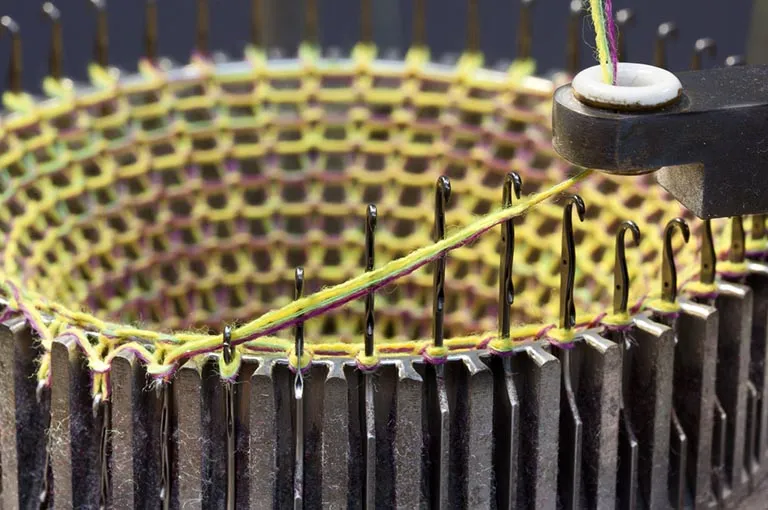
Circular knitting machine needles are the primary stitch-forming elements in weft knitting machines. Mounted in slots (called “tricks”) around a rotating cylinder, these needles move up and down along cam tracks to catch yarn, form loops, and interlock them into continuous tubular fabric.
Each needle performs the same core action: receive the yarn, enclose it, draw a new loop through the old one, and release the old loop. But the mechanism that encloses the yarn differs by needle type — and that difference determines which fabrics, gauges, and production speeds each needle can handle.
A single circular knitting machine can contain anywhere from a few hundred to over 8,000 needles, depending on the cylinder diameter and gauge. For example, a 30-inch diameter machine at gauge E32 holds approximately 2,400 needles. At ultrafine gauge E90, that same diameter holds 8,472 needles — each one thinner than a human hair at 0.18mm.
The 3 Main Types of Circular Knitting Machine Needles
1. Latch Needles (Most Widely Used)
How they work: A latch needle has a small hinged latch (hook) at the tip that pivots open and closed. As the needle rises, the latch opens to catch yarn. As it falls, the latch closes over the yarn, enclosing it to form a loop. This self-acting mechanism requires no external presser.
Key characteristics:
- Easy to replace individually
Best for: Single jersey, double jersey (rib), interlock, pique, fleece, and most standard weft-knitted fabrics. Latch needles dominate modern circular knitting machines running at 20–40 RPM.
Common applications: T-shirts, polo shirts, sportswear, innerwear, casual wear — essentially any high-volume knit fabric production.
Limitations: The latch mechanism adds slight bulk to the needle profile, making it less suitable for ultrafine gauges (E40+) where space is extremely limited. The latch pivot point is also a wear item that requires periodic inspection.
2. Spring-Bearded (Bearded) Needles
How they work: A bearded needle has a flexible, spring-like “beard” (hook) at the tip. To close the hook and enclose the yarn, an external presser bar pushes the beard downward into a groove in the needle stem. This requires precise coordination between the needle and the presser mechanism.
Key characteristics:
- More complex setup and adjustment
Best for: Ultrafine and fine-gauge fabrics where stitch uniformity is critical. Common in high-end jersey, lightweight underwear, and technical textile applications.
Common applications: Fine-gauge cotton jersey, microfiber fabrics, medical textiles, and any application requiring extremely uniform stitch structure.
Limitations: The external presser requirement makes bearded needles slower to operate and more complex to maintain. They are not suitable for high-speed production. The presser mechanism also limits the maximum machine speed.
3. Compound Needles
How they work: A compound needle has two separate elements: a main needle body with a hook, and a separate closing element (a sliding latch or tongue) that moves independently. The closing element slides along the needle stem to open and close the hook, controlled by its own cam track.
Key characteristics:
- More complex cam system required
Best for: Warp knitting machines and high-precision weft knitting applications. Compound needles excel where yarn is delicate, tension control is critical, or production speed must be maximized with minimal vibration.
Common applications: Technical textiles, warp-knitted fabrics, delicate yarn structures, and high-speed fine-gauge production.
Limitations: Higher cost, more complex cam setup, and less common in standard circular weft knitting machines. Primarily used in warp knitting and specialized weft applications.
Needle Type Comparison Table
| Feature | Latch Needle | Spring-Bearded Needle | Compound Needle |
|---|---|---|---|
| Mechanism | Hinged self-acting latch | Flexible beard + external presser | Separate hook + sliding element |
| Gauge Range | E10–E36 (standard) | E24–E90+ (fine/ultrafine) | E18–E40 (precision) |
| Speed | High (20–40 RPM) | Medium (10–25 RPM) | High (25–45 RPM) |
| Maintenance | Low (self-acting) | Medium (presser adjustment) | Higher (dual cam system) |
| Cost | Low–Medium | Medium | High |
| Yarn Compatibility | Wide range | Fine to medium counts | Delicate/specialty yarns |
| Best For | Mass production | Ultrafine fabrics | Technical/precision textiles |
| Market Share | ~80% of circular machines | ~15% (fine-gauge niche) | ~5% (specialized) |
How to Choose the Right Needle for Your Fabric Type
Step 1: Identify Your Target Fabric
Different fabrics demand different needle characteristics:
| Fabric Type | Recommended Needle | Gauge Range | Notes |
|---|---|---|---|
| Single Jersey (T-shirts, casual wear) | Latch | E18–E28 | Most common application |
| Double Jersey / Rib (collars, cuffs) | Latch | E18–E24 | Requires cylinder + dial needles |
| Interlock (sportswear, underwear) | Latch | E24–E32 | Double-bed, fine loop structure |
| Fleece (outerwear, blankets) | Latch | E14–E20 | Heavy yarn, robust needles |
| Jacquard (patterned fabrics) | Latch or Compound | E18–E28 | Pattern precision matters |
| Fine Jersey (premium T-shirts) | Bearded or Latch | E28–E40 | Uniformity is critical |
| Technical Textiles (medical, industrial) | Compound | E24–E40 | Precision and yarn protection |
| Microfiber / Ultrafine | Bearded | E40–E90+ | Only bearded needles work |
Step 2: Match Needle Gauge to Yarn Count
The needle gauge (needles per inch) must match your yarn count (thickness). A general rule: the finer the yarn, the higher the gauge number.
| Yarn Count (Ne) | Recommended Gauge | Needle Type |
|---|---|---|
| 10–20 (coarse) | E10–E16 | Latch |
| 20–30 (medium) | E16–E24 | Latch |
| 30–40 (fine) | E24–E32 | Latch or Bearded |
| 40–60 (very fine) | E32–E40 | Bearded |
| 60+ (ultrafine) | E40–E90 | Bearded |
Step 3: Consider Production Speed Requirements
If you’re running high-volume production (T-shirts, basic jersey), latch needles are the clear choice — they handle 20–40 RPM with minimal maintenance. If fabric quality and stitch uniformity matter more than speed (premium fabrics, technical textiles), bearded or compound needles deliver superior results.
Step 4: Factor in Maintenance and Replacement Costs
Latch needles are the most cost-effective for most operations: they’re widely available, easy to replace individually, and don’t require presser bar adjustments. Bearded needles require more frequent presser bar maintenance. Compound needles have the highest per-needle cost but can reduce overall machine wear due to lower stroke height.
Needle Materials and Coatings
Modern circular knitting machine needles are made from high-carbon steel or alloy steel, with various coatings to extend life and reduce friction:
| Material/Coating | Benefits | Best For |
|---|---|---|
| High-carbon steel | Standard, cost-effective | General purpose |
| Alloy steel | Higher durability, heat resistance | High-speed production |
| Chrome coating | Reduced friction, longer life | All applications |
| Nickel coating | Corrosion resistance | Humid environments |
| Titanium nitride (TiN) | Extreme wear resistance | Abrasive yarns (synthetic, blended) |
| DLC (Diamond-Like Carbon) | Lowest friction, longest life | Premium, high-speed lines |
For factories running synthetic or blended yarns (which are more abrasive than pure cotton), investing in TiN or DLC-coated needles can extend needle life by 30–50%, reducing both replacement costs and downtime.
Common Needle Problems and How to Prevent Them
Needle Breakage
Causes: Excessive tension, yarn defects, incorrect cam timing, worn needle hooks.
Prevention: Regular yarn quality checks, proper tension settings, scheduled needle replacement (typically every 6–12 months for high-speed lines).
Fabric Defects (Holes, Dropped Stitches)
Causes: Bent or worn latches (latch needles), damaged beards (bearded needles), misaligned closing elements (compound needles).
Prevention: Visual inspection every 200–300 operating hours. Replace needles at the first sign of hook or latch wear.
Yarn Breakage at the Needle
Causes: Rough needle surface, incorrect needle gauge for yarn count, burrs on needle hooks.
Prevention: Use coated needles for sensitive yarns. Ensure gauge-to-yarn matching. Polish or replace rough needles.
Inconsistent Stitch Length
Causes: Mixed needle types in the same cylinder, uneven needle wear, cam track wear.
Prevention: Always replace needles in complete sets. Never mix new and worn needles in the same machine.
Frequently Asked Questions
Q: How often should circular knitting machine needles be replaced?
A: For high-speed production lines running 24/7, replace latch needles every 6–12 months. Bearded needles may need replacement every 4–8 months due to beard fatigue. Compound needles last 8–12 months but inspect the closing elements every 3–4 months. Always replace needles in complete sets to ensure uniform fabric quality.
Q: Can I mix latch and bearded needles in the same machine?
A: No. Each needle type requires a different cam system and (for bearded needles) a presser bar. Mixing types will cause immediate fabric defects and potential machine damage. Always use the same needle type throughout a single cylinder.
Q: What’s the difference between needle gauge and machine gauge?
A: They’re related but not identical. Machine gauge refers to the number of needles per inch of cylinder diameter (e.g., E28 = 28 needles per inch). Needle gauge refers to the physical thickness of the individual needle. Higher machine gauge numbers require thinner needles.
Q: Which needle type is best for producing T-shirt fabric?
A: Latch needles at gauge E18–E28 are the standard choice for single jersey T-shirt fabric. They offer the best balance of speed, durability, and fabric quality for cotton and cotton-blend yarns commonly used in T-shirt production.
Q: How do I know if my needles need replacing?
A: Key signs include: visible hook or latch wear under magnification, increased yarn breakage, fabric defects (holes, dropped stitches, lines), and inconsistent stitch length. A simple test: run your fingertip along the needle hook — if you feel any roughness or burrs, replace the needle.
Q: Are coated needles worth the extra cost?
A: For most production environments, yes. TiN or DLC-coated needles cost 20–40% more but last 30–50% longer and reduce yarn breakage. For factories running abrasive synthetic yarns, coated needles typically pay for themselves within 3–6 months through reduced downtime and yarn waste.
Conclusion
Selecting the right circular knitting machine needle comes down to three factors: fabric type, production speed, and maintenance budget. For 80% of circular knitting operations, latch needles deliver the best overall value. For ultrafine and premium fabrics, bearded needles provide unmatched stitch uniformity. For technical textiles and precision applications, compound needles offer the highest control.
The most expensive needle is the wrong one — it wastes yarn, creates defects, and costs you downtime. Match your needle to your fabric, replace on schedule, and invest in coatings that match your yarn type.